


Rosemary has a reputation for being hard to keep alive indoors, and the reputation is earned. Gardening forums are full of the same confession: "I can't keep a potted rosemary alive." Us too. We lost one to a dim bookshelf a few winters back.
The encouraging part: nearly every indoor rosemary death traces back to fixable conditions, and this guide covers all of them. Our guide to growing herbs indoors handles the general care for every pot in your windowsill herb garden; this one stays on rosemary.

Can Rosemary Grow Indoors?
Yes, rosemary can live indoors year-round. It's also one of the harder herbs to keep happy inside, which is why so many people arrive at this question after losing one.
The difficulty comes down to biology. Rosemary (Salvia rosmarinus, reclassified from Rosmarinus officinalis in 2017, which makes it a true sage) is a woody evergreen perennial from the Mediterranean. It evolved for full sun, dry air, lean gritty soil, and constant breeze. A heated winter living room offers almost none of that.
Most indoor rosemary deaths happen in the first winter, and four variables account for nearly all of them: light, drainage, watering rhythm, and airflow.
Maybe you're starting a fresh indoor plant, or maybe a plant that lived outside all summer needs to come in before frost. This guide covers both, with a dedicated overwintering section for the second case.
What Rosemary Needs Indoors
Screenshot this part. These are the conditions rosemary holds you to:
-
Light: 6 to 8 hours of direct sun in an unshaded south-facing window, with west-facing as the runner-up. Bright indirect light, the standard houseplant prescription, isn't enough for rosemary.
-
Temperature: 55 to 70°F. It handles cool rooms far better than hot, dry ones.
-
Humidity: dry conditions at the roots, but moving air around the foliage. These are two separate needs.
-
Soil: gritty, fast-draining, roughly pH 6.0 to 7.5. Use a cactus or succulent mix, or a standard potting mix cut with perlite, pumice, or coarse sand.
-
Container: terracotta with drainage holes. Porous clay walls pull excess moisture out of the root zone.
-
Airflow: enough to keep the dense foliage dry. A small fan or a cracked window on mild days counts.
If you'd rather measure than guess, a simple 4-in-1 soil meter reads pH, moisture, temperature, and light with one probe. One reassurance for pet households: rosemary is non-toxic to cats and dogs.
Choosing a Rosemary Variety for Indoors
Upright varieties handle pot life best. 'Tuscan Blue', 'Salem', 'Arp', and 'Blue Spires' grow vertically, take pruning well, and keep an open shape that air can move through. Creeping or prostrate rosemary looks lovely spilling over a pot edge, but its dense mat holds moisture and makes it the most mildew-prone choice indoors.
If your plant will summer outside in a cold zone, 'Arp' and 'Hill Hardy' tolerate the in-and-out life better than tender varieties.
A note on the rosemary "Christmas trees" sold every December: those sheared topiaries rarely survive the winter, and extension horticulturists warn they die quickly indoors. They arrive root-bound, wrapped in foil that traps water, and land in low-light homes at the darkest time of year. If you received one, remove the foil and check the drainage first.

Setting Up an Indoor Rosemary Plant
Most people start with a nursery plant, so these steps assume one is sitting on your counter.
1) Pick a snug pot
Choose one only 1 to 2 inches wider than the root ball. An oversized pot holds a volume of wet soil the roots can't reach, and that standing moisture is where root rot starts.
2) Mix fast-draining soil
Two parts quality potting mix to one part perlite, pumice, or coarse sand lands close to the sharp drainage rosemary evolved in. A bagged cactus mix also works straight from the bag.
3) Keep the crown clear
Set the plant so the crown, the point where stems meet roots, sits at or slightly above the soil line. Burying it invites rot.
4) Audit the window
Track how many hours of direct sun land on the spot across a full day. Winter changes the answer: the sun sits lower and days shorten, so a window delivering 8 hours in June may deliver 4 in December.
Growing rosemary from seed is possible but slow. Rosemary seed germinates erratically over 2 to 4 weeks, often after a period of cold stratification (a chilled, moist rest that mimics winter), and takes years to reach harvest size. Cuttings or a nursery plant are the realistic route indoors.
Growing Rosemary Under a Grow Light
No unshaded south-facing window? Then a grow light will decide whether your rosemary lives. Rosemary's light appetite sits closer to a succulent's than a typical houseplant's, so supplemental light is the fix, and it often helps plants near a decent window too once winter compresses the daylight.
Look for a full-spectrum LED positioned 10 to 16 inches above the plant canopy, running a 12-to-14-hour photoperiod (the daily stretch of light a plant receives) through winter.
The plant signals a light shortage before it declines. Watch for leggy, stretched stems, wide gaps between leaf nodes, pale new growth, and a plant leaning hard toward the window.
Modern Sprout's Smart Growbar was built for this exact scale of problem: a countertop herb that needs consistent, sun-level light every day of the year regardless of season or window orientation. The app schedules the photoperiod so the hours stay steady even when your attention doesn't. Our full range of grow lights covers bigger setups.
How to Water Rosemary Indoors
Watering rhythm kills more indoor rosemary than anything except light. The rule: water deeply and infrequently, only when the top 2 inches of soil are dry.
Check by pushing a finger 2 inches into the soil, using a moisture meter, or lifting the pot. A dry terracotta pot weighs noticeably less than a saturated one.
"A little water often" is the most common killer. Shallow, frequent watering keeps the surface damp while the deeper root ball stays dry, so the plant is drowning at the top and parched below at the same time. The constantly wet surface also feeds root rot.
In practice you'll land somewhere around every 1 to 2 weeks. How often depends on pot size, light, and season, so treat any fixed schedule as a starting point. In winter, when growth slows, watering drops substantially. Overwatering in December is the classic mistake.
Bottom-watering suits terracotta well: set the pot in an inch of water for 20 to 30 minutes, then always empty the saucer.
Feeding is simpler. Rosemary is a lean feeder, so a diluted balanced fertilizer once a month through spring and summer is plenty, and none in winter.
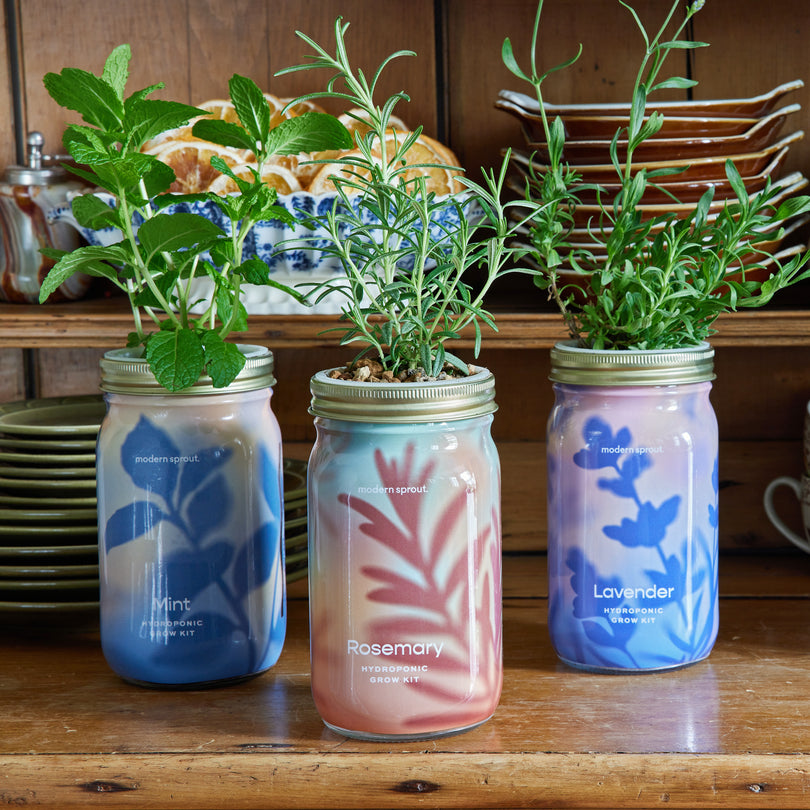
If the rhythm itself is what defeats you, one format removes it. Our Garden Jars grow rosemary in an immersion hydroponic setup, meaning the roots draw water and nutrients directly from a reservoir instead of soil, so over- and under-watering come off the table.
The jar solves the watering variable, and only that one. The plant still needs its 6-plus hours of direct light. The same format runs across our hydroponic grow kits if the jar isn't your look.

Airflow, Humidity, and Powdery Mildew
Almost no rosemary guide takes air seriously, and air separates the plants that make it from the plants that don't.
Still indoor air causes the trouble. Rosemary grows dense foliage, and when stagnant air meets damp soil, powdery mildew follows: a white, dusty film that shows up first on stems and in the crowded interior of the plant. After root rot, it's the leading cause of indoor rosemary collapse.
Prevention is mostly mechanical. Run a small oscillating fan nearby, space plants apart, skip overhead misting (rosemary is one of the few houseplants that wants drier foliage, and misting invites mildew), thin the interior growth, and crack a window on mild days.
If mildew has already arrived, order matters. Prune out affected growth first, improve the airflow second, and only then consider a treatment spray. Most advice reverses this and treats a plant still sitting in the conditions that caused the problem.
Pruning and Harvesting Indoor Rosemary
Indoors, pruning is a health intervention. Every cut opens the canopy so air can move through it, and pinching branch tips pushes the plant to branch sideways and fill out bushier.
Prune during active growth, spring through late summer. Skip deep winter, and skip the weeks right after repotting, when the plant has nothing to spare.
Two limits protect the plant: never remove more than a third of the foliage at once, and never cut into old bare wood, which rarely regrows.

To harvest, snip sprigs of soft green growth above a leaf node (the small bump where leaves emerge), taking from multiple sides to keep the shape even. Clean cuts matter on a woody herb, since ragged tears create entry points for disease. Our needle-nose, spring-assisted Shears were designed for exactly this soft-stem precision work.
Expect garnish-scale harvests. An indoor plant supplies sprigs for roast potatoes, focaccia, or a Sunday chicken. The payoff still lands in your kitchen garden, and our six tips for making the most of your herbs covers storing and using every sprig you snip.
Repotting and Root Pruning
It's time to repot when roots circle out of the drainage holes, water runs straight through without soaking in, or the plant dries out within a day or two of a deep watering.
Repot roughly every 1 to 2 years, ideally in spring, moving up a single pot size.
If you like the pot it's in, root-prune instead. Slide the plant out, trim an inch off the outer root mass, refresh the soil, and return it to the same container. It sounds brutal, and rosemary handles it the way it handles a good haircut.
Overwintering Rosemary Indoors
In zone 7 and colder, rosemary won't reliably survive winter in the ground, so an outdoor plant needs to come inside before frost. Gardeners in zone 8 and warmer can mostly leave rosemary out year-round.
Timing: move the plant in before the first hard frost, once night temperatures start dipping into the low 40s°F. Waiting for frost damage means moving an already stressed plant into a stressful environment.
Acclimate gradually. Over 1 to 2 weeks, shift the plant into progressively more shade so the light reduction happens in steps. An abrupt move from a sunny patio to a windowsill triggers the mass leaf drop that convinces people their plant died overnight.
Inspect before it crosses the threshold. Check the undersides of foliage and the soil surface for aphids, spider mites, and whitefly, and hose the plant down if you find hitchhikers.
Then recalibrate what healthy looks like. Normal winter behavior includes slowed growth, few new shoots, and some interior leaf drop. That's dormancy, and over-correcting it with extra water and fertilizer does more damage than the rest itself.
Come spring, harden off in reverse: a week of gradually increasing outdoor exposure once nights stay above 50°F.
Why Indoor Rosemary Dies (and How to Fix It)
1) Browning or crispy needles
Either underwatering or root rot that has already choked the roots' ability to take up water. The visible symptom is identical, so check the soil: bone-dry soil points to thirst, while damp soil with browning points to rot. Confirm by sliding the plant out and looking at the roots.
2) Yellowing lower leaves
Overwatering, poor drainage, or a pot with no air reaching the roots. Cut the watering frequency and verify water exits the drainage holes.
3) Sudden collapse with soil still damp
Root rot. Healthy roots are firm and pale, while rotted roots turn brown and mushy and smell sour. If firm white roots remain, the plant may be salvageable, and our guide to saving a plant with root rot walks through the triage.
4) Leggy, sparse, stretching growth
Insufficient light. Move the plant to a brighter window or revisit the grow light section above.
5) White dusty film
Powdery mildew. Prune, then airflow, then treatment, in that order.
6) Fine webbing or stippled leaves
Spider mites, which thrive in the dry heat near radiators. Rinse the foliage and move the plant away from heat sources.
7) Brown tips with normal soil moisture
Heat stress. Check for a radiator, heat vent, or fireplace within a few feet and relocate the plant.

Rosemary Care Indoors vs. Outdoors
Is rosemary better in pots or in the ground? In zone 8 and warmer, the ground wins. Everywhere else, the best answer is both, on a seasonal rotation.
Light intensity is the biggest gap between the two settings. Even a bright window delivers a fraction of open-sky sun, which is why indoor plants need the best window in the house or a supplemental light. Watering flips too: pots dry fast in summer but stay wet in heated winter rooms.
Size and lifespan follow the conditions. A potted indoor rosemary stays 1 to 3 feet, while the same plant in the ground in a warm zone becomes a multi-foot shrub. Outdoors, rosemary can live a decade or longer.
Indoors, a plant that clears its first winter can live for years, though many end up as accidental annuals. When that happens, the room's conditions are usually the culprit, and every one of them is fixable.
The healthiest long-term setup is the hybrid: outdoors all summer, indoors before frost, using the overwintering routine above. A plant on that rotation gets the light and airflow of a Mediterranean summer plus frost protection from your kitchen.
Getting Rosemary Past Its First Winter
Everything in this guide compresses to light and water. Give the plant more direct light than feels reasonable, and water it less often and more deeply than instinct suggests. Add moving air and a fast-draining pot, and you've removed the causes behind nearly every indoor rosemary death.
Most plants that fail, fail in the first winter. A plant that reaches spring has proven your window, your pot, and your rhythm, and it can hold that spot for years of fresh sprigs. Cut a few for the pan tonight. The plant will be better for it.

