

If your basil leans harder toward the window every week, you're in good company. We've watched our own windowsill herbs go leggy by November, and we've all wondered whether a grow light would help or simply look nice on the shelf. It helps, and the reason is pretty simple.
So how do grow lights work? A grow light is an electric light that gives plants the colors of light they use for photosynthesis, at a strength and for a number of hours your indoor windows can't supply. Get those settings right and a plant can thrive with very little natural sunlight.
That makes LED grow lights for indoor plants a fix for plenty of plant-parent problems: a north-facing living room, a windowless bathroom, short winter days, seeds you want to start in February, or herbs on a kitchen shelf that need more sun than the shelf gets.

How Grow Lights Turn Electricity Into Plant Food
Inside an LED fixture, electricity runs through small chips called light-emitting diodes, which release that energy as light. The light travels as photons, tiny packets of energy, and when they land on a leaf, the green pigment chlorophyll absorbs them.
Your plant spends that energy on photosynthesis, turning carbon dioxide from the air and water from the roots into sugars that build every new leaf, root, and flower. A sunny window powers the same process, and a grow light carries it into rooms the sun can't reach.
Whether a grow light delivers comes down to three things you control: spectrum (which colors it gives off), intensity (how much light reaches the leaf), and duration (hours on and hours off). When an indoor plant struggles, one of those three is usually off.
The Light Spectrum: Which Colors Plants Crave
Plants draw on a specific slice of light for photosynthesis, running from about 400 to 700 nanometers (nm), the unit used to measure wavelength. Growers call this band PAR, short for photosynthetically active radiation. PAR describes which colors count, and the amount of light gets measured separately.
Chlorophyll absorbs the most energy at two spots in that band: blue light around 430 to 450 nm and red light around 640 to 680 nm. Each color pushes growth in its own direction.
Reading the Rainbow: Blue, Red, Green, and Far-Red
Blue light keeps plants compact. It supports vegetative growth, the leafy, stem-building stage, so you get sturdy stems and well-formed leaves. Seedlings and leafy greens love it.
Red light runs photosynthesis efficiently and plays a big part in flowering and fruiting. Most plants grow best with a healthy dose of both colors.
Green light gets written off more than it should. Leaves absorb less of it (part of why they look green to us), but the green light they do take in travels deeper into the plant and reaches lower leaves that red and blue light have a harder time getting to.
Far-red light sits just past the PAR band, around 700 to 750 nm, at the edge of what our eyes can see. Plants read it as a cue about shade and day length, so it affects how tall they stretch and when they bloom.
Lean too hard on one color and the plant shows it. A mostly blue setup gives you stunted plants with dark leaves and few flowers, while too much red or far-red sends stems up tall and spindly, the classic leggy look.
Purple Glow vs. Natural White Grow Lights
Those pink-purple fixtures glowing in some windows use only red and blue diodes. They hit chlorophyll's favorite colors, but the light feels harsh in a living space and turns leaves a muddy gray, which makes yellowing or pests hard to spot.
White full-spectrum grow lights start with a blue diode coated in phosphor, a material that converts part of that blue into a broad band covering red and green. The mix resembles natural sunlight and grows plants well.
Full spectrum refers to that spread of colors, so how strong the light is still comes down to the fixture and how close it sits.
Our grow lights use full-spectrum 4000K white light with a CRI of 90 or higher (92+ on the Smart Growbar and Smart Landscape Growframe). Kelvin (K) describes the shade of the white, and 4000K is a neutral daylight. CRI, or color rendering index, scores how true colors look under a light on a 0 to 100 scale.
In everyday terms, your pothos looks like a pothos, you can tell when a leaf starts to yellow, and the light doubles as a lamp for the room.

Light Intensity: Why Closer Counts
When a plant struggles under a grow light, the usual cause is too little light reaching its leaves. Growers measure that light with PPFD (photosynthetic photon flux density): the number of usable photons landing on a square meter of leaf each second, written as µmol/m²/s. You don't need a light meter to grow herbs, but ballpark ranges are handy:
-
Low-light foliage plants get by on about 50 to 150.
-
Most herbs and leafy greens like somewhere around 200 to 400.
-
Full-size fruiting crops such as tomatoes need much more than either.
Distance Drains Light Fast
Light spreads out as it travels, so intensity drops quickly as you move a fixture away from a plant. With a small, bulb-style light, doubling the distance leaves roughly a quarter of the light at the leaf. Long bar lights spread their output along their length, so the drop is gentler.
Light is also strongest directly under the fixture and fades toward the edges, so the plant mid-shelf gets more than the one at the end.
Lumens Are Made for Eyes
Lumens measure brightness the way people see it, and our eyes are most sensitive to green-yellow light around 555 nm. So lumens undercount the red and blue light plants lean on. They're fine for comparing two similar white lights, though a lumen figure alone can't predict growth.
Can Plants Get Too Much Light?
They can. Leaves closest to the fixture turn bleached or yellow-green, and tips go crispy or brown. Raise the light, dim it, or trim the hours, and new growth should come in a healthy mid-green.
Hours On, Hours Off: How Long to Run a Grow Light
Photoperiod is the number of hours of light a plant gets each day. Low-light plants get by on about 8 hours, partial-sun plants like around 12, and herbs, seedlings, and full-sun plants do best with 14 to 16 hours of light per day.
Intensity and hours multiply. The total daily dose is called DLI (daily light integral), and if you like math, it's PPFD × hours × 0.0036. A light delivering 200 PPFD for 16 hours adds up to about 11.5 moles of light per square meter per day.
That's why a weaker light can make up some of the difference by staying on longer, though a light that's far too dim won't catch up no matter how many hours it runs.
Do Plants Need Darkness?
Most houseplants and herbs do best with a nightly dark stretch. Plants keep working at night, using the sugars they made during the day, and some flowering plants time their blooms to the length of uninterrupted darkness.
Leaving a grow light on 24/7 runs up your electric bill and stresses plants, so give them at least 8 hours of dark.
Let a Timer Keep Time
Plant babies like the same schedule every day, and keeping that up by flipping a switch is tough (we've forgotten plenty of times, too). A grow light timer or app handles it for you.
The Smart Landscape Growframe runs on our app, where presets match plant types: about 8 hours at lower brightness for shade plants, 12 hours for partial sun, and 16 hours at full brightness for full-sun plants. If you're setting one up, our Growframe basics guide walks you through it.
Grow Lights vs. Regular Light Bulbs
Can any light be used as a grow light? Technically, yes, since any light between 400 and 700 nm drives some photosynthesis. The catch is strength. Regular light bulbs are made for human eyes and sit up on the ceiling, so very little of their light reaches a plant.
Household LED Bulbs: Close Enough to Help a Little
A white household LED uses the same blue-diode-and-phosphor setup as a white grow light, so it does give off wavelengths plants can use. From ceiling height, though, it delivers a small fraction of what an herb needs. Parked very close, it can help a low-light plant a little.
Incandescent and Halogen: More Heat Than Light
These bulbs turn most of their energy into heat (infrared) and very little into usable light. Close enough to help a plant, they'd scorch it, which is why they've mostly dropped out of growing.
Fluorescent: A Cooler Option for Seedlings
Fluorescent grow lights, including T5 HO tubes and compact fluorescents (CFLs), run fairly cool and work well for starting seeds. They use more electricity than LEDs for the same light, and the tubes dim as they age.
HID: Big, Bright, and Built for the Garage
High-intensity discharge (HID) lights, such as metal halide and high-pressure sodium, pour out light and heat. They need ventilation and belong in a greenhouse or garage, well away from your bookshelf.
Under the Hood of an LED Grow Light
Open up an LED grow light and you'll find the diodes, a phosphor coating on white models, a driver or power adapter that feeds the diodes steady current, and a metal housing or heat sink that pulls warmth away. Some add a lens or diffuser to soften the beam.
A direct beam concentrates light on one spot, good for a single plant. A bar light spreads it evenly along a shelf, which suits a row of herbs.
Horticultural LEDs turn more of their electricity into usable light than other common grow light types, an efficiency measured in micromoles per joule (µmol/J). They give off little heat, so an LED can sit close to seedlings without burning them, though the housing still feels warm.
LEDs dim slowly over their rated life, with no sudden burnout. We built our lights to be low-power and long-lasting, and they're rated for 25,000 hours, more than four years at 16 hours a day, so you won't be swapping fixtures anytime soon.
Do Grow Lights Use a Lot of Electricity?
An LED grow light uses surprisingly little. Modern Sprout's Smart Growbar runs off a 27-watt power adapter, and 27 watts is the most it can draw, so the math below is an upper limit.
At full brightness for 16 hours a day, that's about 0.43 kilowatt-hours (kWh) daily, or roughly 13 kWh a month. The U.S. Energy Information Administration projects an average residential rate of about 18 cents per kWh for 2026, which puts the Growbar at about $2 to $2.50 a month at most.
Dimmed or on a shorter schedule, it costs less, and your actual rate depends on where you live. HID fixtures, by comparison, draw hundreds of watts.
Spec Sheet Decoder: How to Read a Grow Light's Specs
-
Wattage: The power the light draws. Compare it alongside light output, since two lights at the same wattage can deliver very different amounts of light.
-
Lumens: Brightness as human eyes see it. Handy for comparing similar white lights.
-
PPFD: The growth number. When a brand lists it, check the distance it was measured at, because the figure drops as the light moves away.
-
Color temperature: Measured in Kelvin, it tells you how the white looks. 3000K reads warm, 4000K neutral, 6500K cool. Lower numbers lean a little redder and higher ones a little bluer, and a full-spectrum grow light can come in any of them.
-
CRI: How true your room and your leaves look under the light, which helps when you're checking for yellowing.
-
Dimming, timers, and app control: These keep brightness and hours consistent day to day.
For reference, the Growbar's spec sheet lists a 15-inch bar, 4000K natural white light, 92+ CRI, 1,480 lumens, a 27-watt adapter, dimming, and app scheduling. Our Smart Growhouse and Smart Landscape Growframe use the same 1,480-lumen, 4000K light.
For the Smart Growbar, start with the hanging heights below, which we set for each growth stage.
How to Use a Grow Light at Home
Start with height. Here's where we recommend positioning the Smart Growbar:
-
Seeds: 4 to 8 inches above the tray.
-
Once seedlings have two or three sets of leaves, raise the light to 6 to 12 inches.
-
Established plants do best with 10 to 16 inches between the light and the canopy (the top layer of leaves).
Stronger fixtures usually hang higher, so if you're using a different light, go by its manual.
Next, match brightness and hours to the plant: lower and shorter for low-light plants, full brightness for 14 to 16 hours for herbs and seedlings. Not sure where your plant falls, or how much your window already gives it? Our guide to how much light indoor plants actually need covers window direction and light levels.
Then watch the plant. Long, pale stems reaching upward mean the light is too far away or too weak, and bleached or crispy leaves near the top mean it's too close or too strong. Adjust an inch or two at a time and give it a week.
If your plant also gets some window light, you can run the grow light for fewer hours. A light doing all the work needs the full schedule. Seedlings also grow sturdier stems with a little moving air, so set the tray near a vent or run a small fan nearby.
Do Grow Lights Really Work? Limits and Downsides
Yes. At the right intensity and for enough hours, grow lights reliably grow houseplants, herbs, leafy greens, and seedlings.
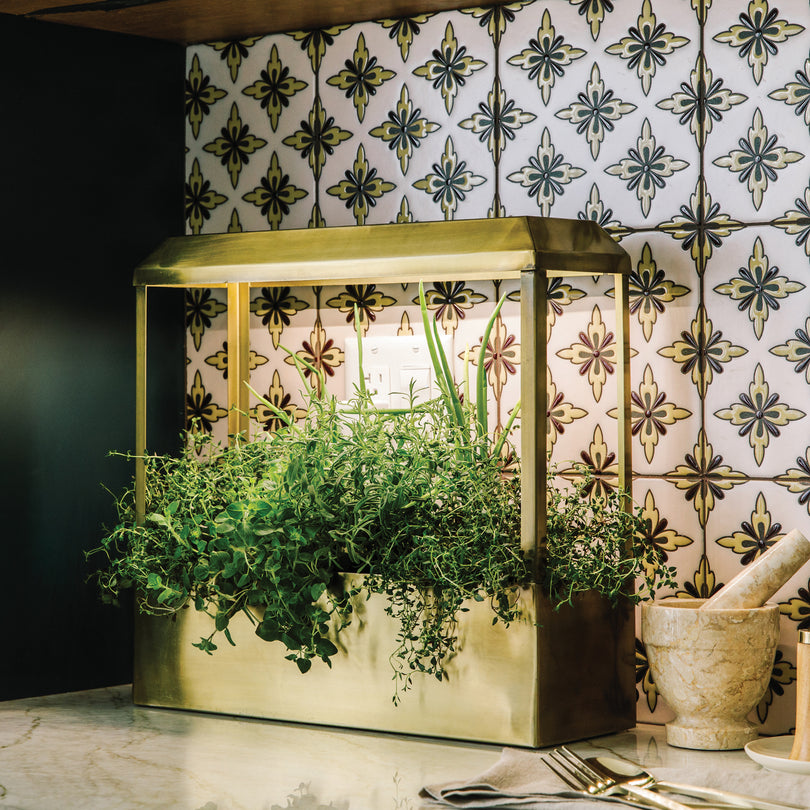
Can plants survive with grow lights only? Most foliage plants and herbs can, which is the idea behind a planter with a built-in grow light. Our Smart Growhouse is a watertight planter with a full-spectrum LED grow light built in, and the wall-mounted Smart Landscape Growframe holds five to seven small pots under its own light.
Full-size tomato and pepper plants are another story. They want more light and elbow room than a countertop or shelf can offer, so they're happiest in a sunny garden bed or greenhouse. Compact flowering and fruiting plants are a better fit: run our lights at full brightness on a 16-hour schedule and they'll support those, too.
Grow lights do come with trade-offs: the upfront cost, a small monthly electric bill, and keeping a schedule. Purple fixtures can make a room feel like a lab, and any bright light at eye level creates glare.
Avoid staring into the diodes, and if you use a red-blue light, expect your leaves to look off-color under it.
Why Your Plant Is Stretching (and How to Stop It)
Leggy, pale herbs are reaching for light they aren't getting. Bring the light down to 10 to 16 inches above the leaves, turn the brightness up, and set a timer for 14 to 16 hours with at least 8 hours of dark. The next set of leaves should come in tighter and greener.
With a full-spectrum white light, color is already handled, and your plant babies and your living room both look like themselves. Shopping for a friend whose pothos lives in a dark apartment? A grow light makes a gift they’ll see working every day, and both the Smart Growhouse and Smart Landscape Growframe are in our gifts over $100.

